

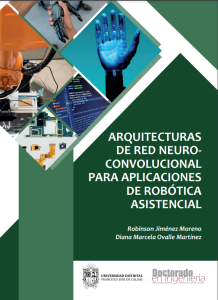
Arquitecturas de Red Neuro-convolucional para Aplicaciones de Robótica Asistencial
Palabras clave:
Robótica personal , Algoritmos (computadores) , Redes neuronales (computadores)Sinopsis
Este libro aborda temáticas actuales pertinentes al desarrollo de la industria 4.0, donde las técnicas de inteligencia artificial y el uso de sistemas robóticos propenden por mejorar la calidad de vida de los seres humanos. Se presenta el desarrollo de arquitecturas paralelas de redes neuronales convolucionales que, en el marco del aprendizaje profundo, hoy día presentan amplios desarrollos dada la robustez que poseen en el reconocimiento de patrones. Dentro de las muchas posibilidades que se encuentran en las arquitecturas paralelas, se propone un aprendizaje independiente por rama, cada una con una arquitectura propia, donde la arquitectura final puede presentarse de forma híbrida. El problema abordado consiste en un robot asistencial que es capaz de reconocer una herramienta de entre un grupo, tomarla y entregarla a un humano, modificando su trayectoria para evitar colisionar con la mano del mismo. Para la aplicación presentada, se desarrolla una red neuronal convolucional paralela con integración difusa en la capa de salida, que es comparada con el uso de una ponderación aritmética basada en la distancia de captación del objeto, para determinar los beneficios de cada una. Además del problema de identificación de la herramienta a distancias variables, se expone un algoritmo de generación de trayectorias con evasión de obstáculos y un algoritmo orientado al agarre de la herramienta. Se plantea un entorno híbrido real-virtual, en el que se verifica la funcionalidad de la red diseñada, así como algunos aspectos por mejorar.
Descargas
Los datos de descarga aún no están disponibles.
Referencias
[Abdel-Malek y Othman, 1999] Abdel-Malek, K. y Othman, S. (1999). Multiple sweeping using the Denavit-Hartenberg representation method. Computer-Aided Design, 31(9):567 – 583.
[Ansari et al., 2012] Ansari, U., Alam, S., y Jafri, S. M. U. N. (2012). Trajectory optimization and adaptive fuzzy based launch vehicle attitude control. En 2012 20th Mediterranean Conference on Control Automation (MED), pp. 457–462.
[Azarang y Kehtarnavaz, 2020] Azarang, A. y Kehtarnavaz, N. (2020). A review of multi-objective deep learning speech denoising methods. Speech Communication, 122:1 – 10.
[Babuska, 2001] Babuska, R. (2001). Fuzzy and neural control. DISC Course Lecture Notes, Delft University of Technology, Delft, The Netherlands.
[Bai et al., 2016] Bai, Y., Chen, Z., Xie, J., y Li, C. (2016). Daily reservoir inflow forecasting using multiscale deep feature learning with hybrid models. Journal of Hydrology, 532:193 – 206.
[Barrientos et al., 2007] Barrientos, A., Balaguer, L. F. P. C., y Aracil, R. (2007). Fundamentos de robótica. McGraw-Hill.
[Bengio, 2009] Bengio, Y. (2009). Learning deep architectures for AI. Found. Trends Mach. Learn., 2(1):1–127.
[Boyd y Vandenberghe, 2004] Boyd, S. y Vandenberghe, L. (2004). Convex Optimization. Cambridge University Press, USA.
[Buchner et al., 2012] Buchner, R., Wurhofer, D., Weiss, A., y Tscheligi, M. (2012). User experience of industrial robots over time. En 2012 7th ACM/IEEE International Conference on Human-Robot Interaction (HRI), pp. 115–116.
[Chen et al., 2018] Chen, L., Zhou, M., Su, W., Wu, M., She, J., y Hirota, K. (2018). Softmax regression based deep sparse autoencoder network for facial emotion recognition in human-robot interaction. Information Sciences, 428:49 – 61.
[Chen et al., 2014] Chen, X., Xiang, S., Liu, C., y Pan, C. (2014). Vehicle detection in satellite images by hybrid deep convolutional neural networks. IEEE Geoscience and Remote Sensing Letters, 11(10):1797–1801.
[Ciregan et al., 2012] Ciregan, D., Meier, U., y Schmidhuber, J. (2012). Multicolumn deep neural networks for image classification. En 2012 IEEE Conference on Computer Vision and Pattern Recognition, pp. 3642–3649
[Cui et al., 2015] Cui, X., Goel, V., y Kingsbury, B. (2015). Data augmentation for deep neural network acoustic modeling. IEEE/ACM Transactions on Audio, Speech, and Language Processing, 23(9):1469–1477.
[Dairi et al., 2018] Dairi, A., Harrou, F., Senouci, M., y Sun, Y. (2018). Unsupervised obstacle detection in driving environments using deep-learningbased stereovision. Robotics and Autonomous Systems, 100:287 – 301.
[Daugherty y Wilson, 2018] Daugherty, P. R. y Wilson, H. J. (2018). Human + machine: reimagining work in the age of AI. Boston, Massachusetts: Harvard Business Review Press.
"[Davis y Mermelstein, 1980] Davis, S. y Mermelstein, P. (1980). Comparison of parametric representations for monosyllabic word recognition
in continuously spoken sentences. IEEE Transactions on Acoustics, Speech,
and Signal Processing, 28(4):357–366."
[Dong et al., 2016] Dong, Y., Liu, Y., y Lian, S. (2016). Automatic age estimation based on deep learning algorithm. Neurocomputing, 187:4 – 10. Recent Developments on Deep Big Vision
[Dwivedi et al., 2014] Dwivedi, K., Biswaranjan, K., y Sethi, A. (2014). Drowsy driver detection using representation learning. En 2014 IEEE International Advance Computing Conference (IACC), pp. 995–999.
[Farooq et al., 2012] Farooq, U., Hasan, K. M., Asad, M. U., y Saleh, S. O. (2012). Fuzzy logic based wall tracking controller for mobile robot navigation. En 2012 7th IEEE Conference on Industrial Electronics and Applications (ICIEA), pp. 2102–2105.
[Gan et al., 2014] Gan, J., Li, L., Zhai, Y., y Liu, Y. (2014). Deep self-taught learning for facial beauty prediction. Neurocomputing, 144:295 – 303.
[Gonzalez y Woods, 2008] Gonzalez, R. y Woods, R. (2008). Procesamiento Digital de Imágenes. Prentice Hall.
[Guechi et al., 2012] Guechi, E., Abellard, A., y Franceschi, M. (2012). Experimental fuzzy visual control for trajectory tracking of a khepera II mobile robot. En 2012 IEEE International Conference on Industrial Technology, pp.25–30.
[Guo et al., 2017] Guo, D., Sun, F., Kong, T., y Liu, H. (2017). Deep vision networks for real-time robotic grasp detection. International Journal of Advanced Robotic Systems, 14(1)
[Guo et al., 2016] Guo, Y., Liu, Y., Oerlemans, A., Lao, S., Wu, S., y Lew, M. S. (2016). Deep learning for visual understanding: A review. Neurocomputing, 187:27 – 48. Recent Developments on Deep Big Vision.
[Gutiérrez et al., 2017] Gutiérrez, M. A., Manso, L. J., Pandya, H., y Núñez, P. (2017). A passive learning sensor architecture for multimodal image labeling: An application for social robots. Sensors (Basel), 17(2).
[Hossain et al., 2017] Hossain, D., Capi, G., y Jindai, M. (2017). Evolution of deep belief neural network parameters for robot object recognition and grasping. Procedia Computer Science, 105:153 – 158. 2016 IEEE International Symposium on Robotics and Intelligent Sensors.
[Hou et al., 2015] Hou, W., Gao, X., Tao, D., y Li, X. (2015). Blind image quality assessment via deep learning. IEEE Transactions on Neural Networks and Learning Systems, 26(6):1275–1286.
[Ji et al., 2014] Ji, N.-N., Zhang, J.-S., y Zhang, C.-X. (2014). A sparse-response deep belief network based on rate distortion theory. Pattern Recognition, 47(9):3179 – 3191.
[Jimenez Moreno, 2011] Jimenez Moreno, R. (2011). Sistema de detección de nivel de cansancio en conductores mediante técnicas de visión por computador. Tesis de máster, Universidad Nacional de Colombia.
[Jiménez Moreno et al., 2017] Jiménez Moreno, R., Avilés, O., y Ovalle, D. M. (2017). Evaluación de hiperparámetros en cnn para detección de patrones de imágenes. Visión electrónica, 11(2):140–145.
[Jiménez-Moreno et al., 2012] Jiménez-Moreno, R., Orjuela, S. A., Hese, P. V., Prieto, F. A., Grisales, V. H., y Philips, W. (2012). Video surveillance formonitoring driver’s fatigue and distraction. En Optics, Photonics, and Digital Technologies for Multimedia Applications II, volumen 8436, pp. 263 – 270.
[Kalashnikov et al., 2018] Kalashnikov, D., Irpan, A., Pastor, P., Ibarz, J., Herzog, A., Jang, E., Quillen, D., Holly, E., Kalakrishnan, M., Vanhoucke, V., y Levine, S. (2018). Scalable deep reinforcement learning for vision-based robotic manipulation. En Proceedings of The 2nd Conference on Robot Learning, volumen 87, pp. 651–673. PMLR.
[Kiguchi y Hayashi, 2013] Kiguchi, K. y Hayashi, Y. (2013). Upper-limb tremor suppression with a 7DOF exoskeleton power-assist robot. En 2013 35th Annual International Conference of the IEEE Engineering in Medicine and Biology Society (EMBC), pp. 6679–6682.
[Kim et al., 2015a] Kim, S., Choi, Y., y Lee, M. (2015a). Deep learning with support vector data description. Neurocomputing, 165:111 – 117.
[Kim et al., 2015b] Kim, S., Yu, Z., Kil, R. M., y Lee, M. (2015b). Deep learning of support vector machines with class probability output networks. Neural Networks, 64:19 – 28. Special Issue on “Deep Learning of Representations”.
[Kopman et al., 2015] Kopman, V., Laut, J., Acquaviva, F., Rizzo, A., y Porfiri, M. (2015). Dynamic modeling of a robotic fish propelled by a compliant tail. IEEE Journal of Oceanic Engineering, 40(1):209–221.
[Koumakis, 2020] Koumakis, L. (2020). Deep learning models in genomics; are we there yet? Computational and Structural Biotechnology Journal, 18:1466 – 1473.
[Lenz et al., 2015] Lenz, I., Lee, H., y Saxena, A. (2015). Deep learning for detecting robotic grasps. The International Journal of Robotics Research, 34(4- 5):705–724.
[Liu et al., 2015] Liu, H., Ma, B., Qin, L., Pang, J., Zhang, C., y Huang, Q. (2015). Set-label modeling and deep metric learning on person re-identification. Neurocomputing, 151:1283 – 1292.
[Lu et al., 2017] Lu, K., An, X., Li, J., y He, H. (2017). Efficient deep network for vision-based object detection in robotic applications. Neurocomputing, 245:31 – 45.
[Längkvist et al., 2014] Längkvist, M., Karlsson, L., y Loutfi, A. (2014). A review of unsupervised feature learning and deep learning for time-series modeling. Pattern Recognition Letters, 42:11 – 24.
[Moreno et al., 2013] Moreno, R. J., Espinosa, F. A., y Hurtado, D. A. (2013). Teleoperated systems: A perspective on telesurgery applications. Revista Ingeniería Biomédica, 7:30 – 41.
[Moreno y Lopez, 2013] Moreno, R. J. y Lopez, J. D. (2013). Trajectory planning for a robotic mobile using fuzzy c-means and machine vision. En Symposium of Signals, Images and Artificial Vision - 2013: STSIVA - 2013, pp. 1–4.
[Moreno et al., 2017] Moreno, R. J., Umaña, L. A. R., y Baquero, J. E. M. (2017). Virtual environment for robotic assistance. IJAER, 12(22):12315– 12318.
[Moreno et al. , 2018] Moreno, R. J., Mauledoux, M., y Martinez, B. J. (2018). Algorithm for object grasp detection. Research Journal of Applied Sciences, 13:162–175.
[Murillo et al., 2018] Murillo, P. U., Jimenez, R., y Beleño, R. H. (2018). Algorithm for tool grasp detection. International Review of Mechanical Engineering (IREME), 12(1).
[Neukart y Moraru, 2014] Neukart, F. y Moraru, S.-A. (2014). A machine learning approach for abstraction based on the idea of deep belief artificial neural networks. Procedia Engineering, 69:1499 – 1508. 24th DAAAM International Symposium on Intelligent Manufacturing and Automation, 2013.
[Ochiai et al., 2014] Ochiai, T., Matsuda, S., Lu, X., Hori, C., y Katagiri, S. (2014). Speaker adaptive training using deep neural networks. En 2014 IEEE International Conference on Acoustics, Speech and Signal Processing (ICASSP), pp. 6349–6353.
[Pachon-Suescun et al., 2020] Pachon-Suescun, C. G., Enciso-Aragon, C. J., y Jimenez-Moreno, R. (2020). Robotic navigation algorithm with machine vision. International Journal of Electrical and Computer Engineering (IJECE), 10.
[Palomares et al., 2016] Palomares, F. G., Serrá, J. A. M., y Martínez, E. A. (2016). Aplicación de la convolución de matrices al filtrado de imágenes. Modelling in Science Education and Learning, 9(1):97–108.
[Pan y Yang, 2010] Pan, S. J. y Yang, Q. (2010). A survey on transfer learning. IEEE Transactions on Knowledge and Data Engineering, 22(10):1345– 1359.
[Perconti y Plebe, 2020] Perconti, P. y Plebe, A. (2020). Deep learning and cognitive science. Cognition, 203:104365.
[Pinzon et al., 2018]. Pinzon, J. O., Jimenez-Moreno, R., Aviles, O., Nino, P., y Ovalle, D. (2018). Very deep convolutional neural network for speech recognition based on words. Journal of Engineering and Applied Sciences, 13:6680–6685.
[Pinzón et al., 2017] Pinzón, J., Jiménez, R., y Hernandez, R. (2017). Deep convolutional neural network for hand gesture recognition used for humanrobot interaction. Journal Of Engineering and Applied Sciences, 12:9278 – 9285.
[Pinzón-Arenas et al., 2019] Pinzón-Arenas, J., Jiménez-Moreno, R., y Pachón- Suescún, C. (2019). Handwritten word searching by means of speech commands using deep learning techniques. International Review on Modelling and Simulations (IREMOS), 12(4).
[Pinzón-Arenas y Jiménez-Moreno, 2020] Pinzón-Arenas, J. O. y Jiménez- Moreno, R. (2020). Comparison between handwritten word and speech record in real-time using CNN. International Journal of Electrical and Computer Engineering (IJECE), 10:4313–4321.
[Pramparo y Moreno, 2017] Pramparo, L. y Moreno, R. J. (2017). Colorimeter using artificial neural networks. Journal of Engineering and Applied Sciences, 12:5332–5337.
[Qian y Woodland, 2016] Qian, Y. y Woodland, P. C. (2016). Very deep convolutional neural networks for robust speech recognition. En 2016 IEEE Spoken Language Technology Workshop (SLT), pp. 481–488.
[Rioux-Maldague y Giguère, 2014] Rioux-Maldague, L. y Giguère, P. (2014). Sign language fingerspelling classification from depth and color images using a deep belief network. En 2014 Canadian Conference on Computer and Robot Vision, pp. 92–97.
[Salehi et al., 2020] Salehi, A. W., Baglat, p., y Gupta, G. (2020). Review on machine and deep learning models for the detection and prediction ofcoronavirus. Proceedings on Materials Today.
[Schmidhuber, 2015] Schmidhuber, J. (2015). Deep learning in neural networks: An overview. Neural Networks, 61:85 – 117.
[Shang et al., 2014] Shang, C., Yang, F., Huang, D., y Lyu, W. (2014). Datadriven soft sensor development based on deep learning technique. Journal of Process Control, 24(3):223 – 233.
[Song et al., 2014] Song, I., Kim, H., y Jeon, P. B. (2014). Deep learning for real-time robust facial expression recognition on a smartphone. En 2014 IEEE International Conference on Consumer Electronics (ICCE), pp. 564–567.
[Tamilselvan y Wang, 2013] Tamilselvan, P. y Wang, P. (2013). Failure diagnosis using deep belief learning based health state classification. Reliability Engineering & System Safety, 115:124 – 135.
[Thulasiraman y Swamy, 1992] Thulasiraman, K. y Swamy, M. N. S. (1992). Graphs: Theory and Algorithms. John Wiley & Sons, Inc., USA.
[Useche et al., 2018] Useche, P. C., Beleno, R. D. H., y Moreno, R. J. (2018). Manipulation of tools by means of a robotic arm using artificial intelligence. Journal of Engineering and Applied Sciences, 13: 3479 – 3492.
[Velandia et al., 2019] Velandia, N. S., Moreno, R. J., y Rubiano, A. (2019). CNN architectures for hand gesture recognition using EMG signals throw wavelet feature extraction. Journal of Engineering and Applied Sciences, 14:3528–3537.
[Viola y Jones, 2001] Viola, P. y Jones, M. (2001). Rapid object detection using a boosted cascade of simple features. En Proceedings of the 2001 IEEE Computer Society Conference on Computer Vision and Pattern Recognition.
[Walid y Lasfar, 2014] Walid, R. y Lasfar, A. (2014). Handwritten digit recognition using sparse deep architectures. En 2014 9th International Conference on Intelligent Systems: Theories and Applications (SITA-14), pp.1–6.
[Wang y Morel, 2014] Wang, Y. y Morel, J. (2014). Can a single image denoising neural network handle all levels of gaussian noise? IEEE Signal Processing Letters, 21(9):1150–1153.
[Wang et al., 2016] Wang, Z., Li, Z., Wang, B., y Liu, H. (2016). Robot grasp detection using multimodal deep convolutional neural networks. Advances in Mechanical Engineering, 8(9)
[Weber, 2010] Weber, W. (2010). Automatic generation of the DenavitHartenberg convention. En ISR 2010 (41st International Symposium on Robotics) and ROBOTIK 2010 (6th German Conference on Robotics), pp. 1–7.
[Wu et al., 2014] Wu, K., Chen, X., y Ding, M. (2014). Deep learning based classification of focal liver lesions with contrast-enhanced ultrasound. Optik, 125(15):4057 – 4063.
[You et al., 2014] You, Z., Wang, X., y Xu, B. (2014). Exploring one pass learning for deep neural network training with averaged stochastic gradient descent. En 2014 IEEE International Conference on Acoustics, Speech and Signal Processing (ICASSP), pp. 6854–6858.
[Young et al., 2006] Young, S. J., Evermann, G., Gales, M., Hain, T., Kershaw, D., Moore, G. L., Odell, J. J., Ollason, D., Povey, D., Valtchev, y Woodland, P. C. (2006). The HTK book version 3.4.
[Zeiler y Fergus, 2014] Zeiler, M. D. y Fergus, R. (2014). Visualizing and understanding convolutional networks. En Computer Vision – ECCV 2014, pp. 818–833, Cham. Springer International Publishing.
[Zhang y Zhang, 2014] Zhang, C. y Zhang, Z. (2014). Improving multiview face detection with multi-task deep convolutional neural networks. En IEEE Winter Conference on Applications of Computer Vision, pp. 1036– 1041.
[Zhang et al., 2020] Zhang, H., Hongyu, L., Nyayapathi, N., Wang, D., Le, A., Ying, L., y Xia, J. (2020). A new deep learning network for mitigating limitedview and under-sampling artifacts in ring-shaped photoacoustic tomography. Computerized Medical Imaging and Graphics.
[Zhang et al., 2015a] Zhang, Y., Li, X., Zhang, Z., Wu, F., y Zhao, L. (2015a). Deep learning driven blockwise moving object detection with binary scene modeling. Neurocomputing, 168:454 – 463.
[Zhang et al., 2015b] Zhang, Y., Li, X., Zhang, Z., Wu, F., y Zhao, L. (2015b). Deep learning driven blockwise moving object detection with binary scene modeling. Neurocomputing, 168:454 – 463.
Descargas
Publicado
October 30, 2020
Colección
Derechos de autor 2020 Universidad Distrital Francisco José de Caldas
Licencia

Esta obra está bajo una licencia internacional Creative Commons Atribución-NoComercial-SinDerivadas 4.0.
Detalles sobre esta monografía
ISBN-10 (02)
978-958-787-238-5
ISBN-13 (15)
978-958-787-237-8
Loading...