

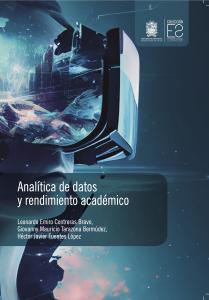
Analítica de datos y rendimiento académico
Sinopsis
En la literatura se encuentran diversos medios que, según las investigaciones, facilitan o ayudan al proceso educativo, como los dispositivos móviles (tabletas y teléfonos) y los reproductores de música como medio de formación de los estudiantes; este proceso es conocido como Mobile Learning (M-Learning). De forma similar, se encuentran también los juegos como estrategia de enseñanza (Game-Learning o G-Learning), así como el uso de las potencialidades del aprendizaje electrónico (E-Learning) y de la enseñanza presencial, que dan origen al aprendizaje bimodal (B-Learning).
La analítica del aprendizaje (learning analytics) es un nuevo paradigma desarrollado por la generación de un alto volumen de datos que requieren ser analizados por herramientas cada vez más sofisticadas, como el software de visualización, que ha incursionado en diferentes disciplinas como la física, la ingeniería, la biología y la medicina; el aprendizaje recibe la incursión debido a medios tecnológicos como internet y plataformas conocidas como sistemas de gestión de aprendizaje.
En este documento se analiza la información bibliográfica, con el objetivo de identificar las herramientas, variables y campos que influyen sobre el rendimiento académico a nivel superior. El rendimiento académico es uno de los indicadores más estudiados por la comunidad científica en el ámbito educativo, a juzgar por la cantidad de trabajos que involucran las áreas de la psicología, la estadística y la ciencia de datos en los que se han establecido diversos modelos que permitan comprender este fenómeno de la vida académica.
Capítulos
-
Capítulo 1Introducción
-
Capítulo 2Objetivos de la investigación
-
Capítulo 3Metodología
-
Capítulo 4Tecnología y analítica en educación
-
Capítulo 5Rendimiento académico
-
Capítulo 6Machine Learning
-
Capítulo 7Tecnología y analítica del aprendizaje
-
Capítulo 8Tecnología y analítica académica
-
Capítulo 9Caracterización de metodologías para la evaluación del rendimiento académico en la educación superior
-
Capítulo 10Resumen de investigaciones sobre analítica académica, analítica del aprendizaje y metodologías para determinar el rendimiento académico
Descargas
Los datos de descarga aún no están disponibles.
Referencias
Abdullah, A., Asar, A. K. y Alnisa’Anis Alanna Binti Ruzelan, N. (2020). A novel learning engagement data model (LEDM) for online attendance system. IOP Conference Series: Materials Science and Engineering, 769(1), 012026. https://doi.org/10.1088/1757-899X/769/1/012026
Adekitan, A. I. y Noma-Osaghae, E. (2019). Data mining approach to predicting the performance of first year student in a university using the admission requirements. Education and Information Technologies, 24(2), 1527-1543. https://doi.org/10.1007/s10639-018-9839-7
Adell, J. (1994). World Wide Web: un sistema hipermedia distribuido para la docencia universitaria. Nuevas Tecnologías de la Información y la Comunicación para la Educación. Ediciones Alfar, 114-121. http://nti.uji.es/docs/nti/badajoz.html
Agudo-Peregrina, Á. F., Iglesias-Pradas, S., Conde-González, M. Á. y Hernández-García, Á. (2014). Can we predict success from log data in VLEs? Classification of interactions for learning analytics and their relation with performance in VLE-supported F2F and online learning. Computers in Human Behavior, 31, 542-550. https://doi.org/10.1016/j.chb.2013.05.031
Ahamed, A. T. M. S., Mahmood, N. T. y Rahman, R. M. (2016). Prediction of HSC examination performance using socioeconomic, psychological and academic factors. International Conference on Electrical and Computer Engineering, 263-266.
Ahmad, F., Ismail, N. H. y Aziz, A. A. (2015). The prediction of students’ academic performance using classification data mining techniques. Applied Mathematical Sciences, 9(129), 6415-6426. https://doi.org/10.12988/ams.2015.53289
Ajibade, S. M., Ahmad, N. B. y Shamsuddin, S. M. (2019). An heuristic feature selection algorithm to evaluate academic performance of students. 10th Control and System Graduate Research Colloquium (ICSGRC), 2-3.
Ajibade, S. S. M., Bahiah Binti Ahmad, N. y Mariyam Shamsuddin, S. (2019). Educational data mining: Enhancement of student performance model using ensemble methods. IOP Conference Series: Materials Science and Engineering, 551(1). https://doi.org/10.1088/1757-899X/551/1/012061
Akçapınar, G., Altun, A. y Aşkar, P. (2019). Using learning analytics to develop early-warning system for at-risk students. International Journal of Educational Technology in Higher Education, 16(1). https://doi.org/10.1186/s41239-019-0172-z
Al-araibi, A. A. M., Mahrin, M. N. bin y Yusoff, R. C. M. (2019). Technological aspect factors of E-Learning readiness in higher education institutions: Delphi technique. Education and Information Technologies, 24(1), 567-590. https://doi.org/10.1007/s10639-018-9780-9
Al-araibi, A. A. M., Naz’ri bin Mahrin, M., Yusoff, R. C. M. y Chuprat, S. B. (2019). A model for technological aspect of E-Learning readiness in higher education. Education and Information Technologies, 24(2), 1395-1431. https://doi.org/10.1007/s10639-018-9837-9
Al-Barrak, Mashael A. y Al-Razgan, Muna. (2016). Predicting students final GPA using decision trees: A case study. International Journal of Information and Education Technology, 6-7, 528-533. https://doi.org/10.7763/IJIET.2016.V6.745
Albela-García, G. P., Luna-Yáñez, C., Orezzoli, H. M., Guevara-Canales, J.-O. y García, H. (2020). Relación del rendimiento académico con técnicas de aprendizaje en estudiantes de odontología de la asignatura de radiología. Kiru, 17(4), 2410-2717. https://doi.org/10.24265/kiru.2020.v17n4.01
Almaiah, M. A., Al-Khasawneh, A. y Althunibat, A. (2020). Exploring the critical challenges and factors influencing the E-Learning system usage during COVID-19 pandemic. Education and Information Technologies, 25, 5261-5280. https://doi.org/10.1007/s10639-020-10219-y
Almarabeh, H. (2017). Analysis of students’ performance by using different data mining classifiers. International Journal of Modern Education and Computer Science, 8, 9-15. https://doi.org/10.5815/ijmecs.2017.08.02
Aluko, R. O., Daniel, E. I., Oshodi, O. S., Aigbavboa, C. O. y Abisuga, A. O. (2018). Towards reliable prediction of academic performance of architecture students: Using data mining techniques. Journal of Engineering, Design and Technology, 16(3), 385-397. https://wlv.openrepository.com/bitstream/handle/2436/623424/Daniel_Towards_Reliable_Prediction_2020.pdf
Alves, P., Morais, C. y Miranda, L. (2017). Learning analytics in higher education: Assessing learning outcomes. Conferencia Europea sobre E-Learning, 25-32.
Alyahyan, E. y Düştegör, D. (2020). Predicting academic success in higher education: Literature review and best practices. International Journal of Educational Technology in Higher Education, 17(3). https://doi.org/10.1186/s41239-020-0177-7
Amat, J. (2016). Test exacto de Fisher, chi-cuadrado de Pearson, McNemar y Q-Cochran. En Test estadísticos para variables cualitativas. https://rpubs.com/Joaquin_AR/220579
Amazona, M. V. y Hernández, A. A. (2019). Modelling student performance using data mining techniques. Proceedings of the 2019. 5th International Conference on Computing and Data Engineering (ICCDE), 19, 36-40. https://doi.org/10.1145/3330530.3330544
Anuradha, C. y Velmurugan, T. (2015). A comparative analysis on the evaluation of classification algorithms in the prediction of students performance. Indian Journal of Science and Technology, 8(15).
Argonza, J. (2016). Big Data en la educación. Revista Digital Universitaria, 17(1), 1-16. http://www.revista.unam.mx/vol.17/num1/art06/
Asif, R., Merceron, A., Ali, S. A. y Haider, N. G. (2017). Analyzing undergraduate students’ performance using educational data mining. Computers and Education, 113, 177-194. https://doi.org/10.1016/j.compedu.2017.05.007
Avella, J. T., Kebritchi, M., Nunn, S. G. y Kanai, T. (2016). Learning analytics methods, benefits, and challenges in higher education: A systematic literature review. Journal of Asynchronous Learning Network, 20(2). https://doi.org/10.24059/olj.v20i2.790
Awadalla, S., Davies, E. B. y Glazebrook, C. (2020). A longitudinal cohort study to explore the relationship between depression, anxiety and academic performance among Emirati university students. BMC Psychiatry, 20(448). https://bmcpsychiatry.biomedcentral.com/track/pdf/10.1186/s12888-020-02854-z.pdf
Ayesha, Sh., Mustafá, T., Sattar, A. R. y Khan, M. I. (2010). Data mining model for higher education system. European Journal of Scientific Research, 43, 24-32. http://connection.ebscohost.com/c/articles/52621007/data-mining-model-higher-education-system
Azcona, D., Hsiao, I. H. y Smeaton, A. F. (2019). Detecting students-at-risk in computer programming classes with learning analytics from students’ digital footprints. User Modeling and User-Adapted Interaction, 29(4), 759-788. https://doi.org/10.1007/s11257-019-09234-7
Azzi, I., Jeghal, A., Radouane, A., Yahyaouy, A. y Tairi, H. (2020). A robust classification to predict learning styles in adaptive E-Learning systems. Education and Information Technologies, 25(1), 437-448. https://doi.org/10.1007/s10639-019-09956-6
Back, D. A., Behringer, F., Harms, T., Plener, J., Sostmann, K. y Peters, H. (2015). Survey of E-Learning implementation and faculty support strategies in a cluster of mid-European medical schools. BMC Medical Education, 15(145), 1-9. https://doi.org/10.1186/s12909-015-0420-4
Baepler, P. y Murdoch, C. J. (2010). Academic analytics and data mining in higher education. International Journal for the Scholarship of Teaching & Learning, 4(2). https://doi.org/10.20429/ijsotl.2010.040217
Bagnato, J. (s.f.). Aprende machine learning. https://www.aprendemachine-learning.com
Bahammam, A. S., Alaseem, A. M., Alzakri, A. A., Almeneessier, A. S. y Sharif, M. M. (2012). The relationship between sleep and wake habits and academic performance in medical students: A cross-sectional study. BMC Medical Education, 12(61). https://doi.org/10.1186/1472-6920-12-61
Bajpai, P. y Maneesha. (2018). Analyzing effect of social media on academic performance of university graduates. ACM International Conference Proceeding Series, 40-44. https://doi.org/10.1145/3234825.3234830
Banihashem, S. K., Aliabadi, K., Pourroostaei Ardakani, S., Delaver, A. y Nili Ahmadabadi, M. (2018). Learning analytics: A systematic literature review. Interdisciplinary Journal of Virtual Learning in Medical Sciences, 9(2), 63024. https://doi.org/10.5812/ijvlms.63024
Bautista-Rodríguez, G. y Gatica-Lara, F. (2020). Factores relacionados con el rendimiento académico en una carrera técnica en salud impartida en línea. Investigación en Educación Médica, 9(33), 89-97. http://www.scielo.org.mx/pdf/iem/v9n33/2007-5057-iem-9-33-89.pdf
Bayona, E. (2017). Hábitos de estudio y rendimiento académico en ingeniería de sistemas. Revista Colombiana de Computación, 18(1), 61-69. https://doi.org/10.29375/25392115.3198
Benavides, E. S. y Pérez Montero, E. L. (2015). Estructuras de decisión a partir del aprendizaje autorregulado en ambientes B-Learning. Revista Tecnura, 15-24. https://doi.org/10.14483/udistrital.jour.tecnura.2015.SE1.a01
Bhutto, S., Siddiqui, I. F., Arain, Q. A. y Anwar, M. (2020). Predicting students’ academic performance through supervised (ICISCT). 2nd International Conference on Information Science and Communication Technology. https://doi.org/10.1109/ICISCT49550.2020.9080033
Boneu, J. (2007). Plataformas abiertas de E-Learning para el soporte de contenidos educativos abiertos. Revista de Universidad y Sociedad del Conocimiento, 4(1), 36-47. https://www.redalyc.org/pdf/780/Resumenes/Abstract_78040109_2.pdf
Bonsaksen, T. (2016). Predictors of academic performance and education programme satisfaction in occupational therapy students. British Journal of Occupational Therapy, 79(6). https://doi.org/10.1177/0308022615627174
Bote-Lorenzo, M. L., Gómez-Sánchez, E. y Asensio-Pérez, J. I. (2019). Aligning learning design and learning analytics through instructor involvement: A MOOC case study. Interactive Learning Environments, 1, 1-15.
Brownlee, J. (2020). Mastery. https://machinelearningmastery.com/
Buhagiar, T. y Leo, C. (2018). Does gamification improve academic performance? Journal of Instructional Pedagogies, 20, 1-6. https://files.eric.ed.gov/fulltext/EJ1178731.pdf
Burgos, C., Campanario, M. L., Peña, D. de la, Lara, J. A., Lizcano, D. y Martínez, M. A. (2018). Data mining for modeling students’ performance: A tutoring action plan to prevent academic dropout. Computers and Electrical Engineering, 66, 541-556. https://doi.org/10.1016/j.compeleceng.2017.03.005
Burman, I. y Som, S. (2019). Predicting students academic performance using support vector machine. ProceedingsK. Amity International Conference on Artificial Intelligence (AICAI) 2019, 756-759. https://doi.org/10.1109/AICAI.2019.8701260
Campbell, J. P. y Oblinger, D. (2007). Academic analytics: A new tool for a new era. EDUCAUSE Review, 42(4), 40-57. https://er.educause.edu/articles/2007/7/academic-analytics-a-new-tool-for-a-new-era
Campo-Arias, A., Oviedo, H. C. y Herazo, E. (2014). Escala de estrés percibido-10: desempeño psicométrico en estudiantes de medicina de Bucaramanga, Colombia. Rev. Fac. Med., 62(3), 407-413. https://doi.org/10.15446/revfacmed.v62n3.43735
Castrillón, O. D., Sarache, W. y Ruiz-Herrera, S. (2020). Prediction of academic performance using artificial intelligence techniques. Formacion Universitaria, 13(1), 93-102. https://doi.org/10.4067/S0718-50062020000100093
Castro, I. de y Closas, A. (2020). Modelo estructural de las relaciones entre enseñanza en contextos tecnológicos y el rendimiento académico en contabilidad. Cuaderno de Pedagogía, 17(34), 31-47. https://cuaderno.pucmm.edu.do/index.php/cuadernodepedagogia/article/view/394/409
Catalán, H. (s.f.). Curso internacional: construcción de escenarios económicos y econometría avanzada. Universidad Nacional de Colombia. https://www.cepal.org/sites/default/files/courses/files/04_pruebas_especificacion.pdf
Céspedes, R. C., Vara-Horna, A., López-Odar, D., Díaz-Rosillo, A. y Asencios-González, Z. (2018). Ausentismo, presentismo y rendimiento académico en estudiantes de universidades peruanas. Propósitos y Representaciones, 6(1), 83-133. https://doi.org/10.20511/pyr2018.v6n1.177
Chen, H. J. (2020). Clarifying the impact of surprise in E-Learning system design based on university students with multiple learning goals orientation. Education and Information Technologies, 25, 5873-5892. https://doi.org/10.1007/s10639-020-10249-6
Chen, L., Yoshimatsu, N., Goda, Y., Okubo, F., Taniguchi, Y., Oi, M., Konomi, S., Shimada, A., Ogata, H. y Yamada, M. (2019). Direction of collaborative problem solving-based STEM learning by learning analytics approach. Research and Practice in Technology Enhanced Learning, 14(24). https://doi.org/10.1186/s41039-019-0119-y
Chilca, M. (2017). Autoestima, hábitos de estudio y rendimiento académico en estudiantes universitarios. Propósitos y Representaciones, 5(1), 71-127. https://dialnet.unirioja.es/servlet/articulo?codigo=5904759
Clow, D. (2013). An overview of learning analytics. Teaching in Higher Education, 18(6), 683-695. https://doi.org/10.1080/13562517.2013.827653
Coaten, N. (2003). Educaweb. Suplemento del boletín de educaweb | ISSN: 1578-5793. https://www.educaweb.com/esp/servicios/monografico/formacionvirtual/1181076-a.html
Contreras, L. E., Fuentes, H. J. y Rodríguez, I. (2020). Academic interruption model using automatic learning algorithms. International Journal of Mechanical and Production Engineering Research and Development (IJMPERD), 10(3), 16075-16086. www.tjprc.org
Contreras, L., González, K. y Fuentes, H. (2011). Use of ICT and especially of blended learning in higher education. Revista Educación y Desarrollo Social, 5(1), 151-160. https://doi.org/10.18359/REDS.898
Contreras, L., Fuentes, H. y Molano, J. (2021). Analítica académica: nuevas herramientas aplicadas a la educación. Revista Boletín Redipe, 10(3), 137-158.
Contreras, L., Fuentes, H. y Rodríguez, J. (2020). Academic performance prediction by as a success/failure indicator for engineering students. Formación Universitaria, 13(5), 233-246. https://doi.org/10.4067/S0718-50062020000500233
Costa, E. B., Fonseca, B., Santana, M. A., de Araújo, F. F. y Rego, J. (2017). Evaluating the effectiveness of educational data mining techniques for early prediction of students’ academic failure in introductory programming courses. Computers in Human Behavior, 73, 247-256. https://doi.org/10.1016/j.chb.2017.01.047
Cotter, E. W. y Kelly, N. R. (2016). Binge eating scale (BES). In Encyclopedia of Feeding and Eating Disorders (pp. 1-5). Springer. https://doi.org/10.1007/978-981-287-087-2_9-2
Cresswell, J. y Underwood, C. (2004). Location, location, location: Implications of geographic situation on Australian student performance in PISA 2000. Australian Council for Educational Research.
Daniel, B. (2015a). Big Data and analytics in higher education: Opportunities and challenges. British Journal of Educational Technology, 46-5(0007-1013), 904-920. https://www.learntechlib.org/p/151804/
Daniel, B. (2015b). Big Data and analytics in higher education: Opportunities and challenges. British Journal of Educational Technology, 46(5), 904-920. https://doi.org/10.1111/bjet.12230
David, J. y Anastasija, G. (2019). Predicting academic performance based on students’ family environment: Evidence for Colombia using classification trees. Psychology, Society and Education, 11(3), 299-311. https://www.uco.es/ucopress/ojs/index.php/psye/article/view/13947
De Arco Paternina, L. K., Barrios Barceló, H. de J. y Parra Ortega, G. M. (2017). Análisis de factibilidad de un sistema de educación B-Learning: caso de estudio. Universidad de San Buenaventura. Revista Academia y Virtualidad, 10(2), 7-19. https://doi.org/10.18359/ravi.2706
Deliens, T., Clarys, P., Bourdeaudhuij, I. de y Deforche, B. (2013). Weight, socio-demographics, and health behaviour related correlates of academic performance in first year university students. Nutrition Journal, 12, 162. https://doi.org/10.1186/1475-2891-12-162
Depaula, P. D. y Azzollini, S. C. (2013). Analysis of the Big five model of personality as a predictor of cultural intelligence. PSIENCIA Revista Latinoamericana de Ciencia Psicológica, 5(1), 35-43. https://doi.org/10.5872/psiencia/5.1.24
Devasia, T., Vinushree, T. P. y Hegde, V. (2016). Prediction of students performance using educational data mining. International Conference on Data Mining and Advanced Computing (SAPIENCE), 91-95.
Díaz-Pinzón, J. E. (2020). Estudio comparativo entre el contagio durante la cuarentena obligada por el COVID-19 y el contagio durante la apertura gradual y controlada para algunos sectores de la economía en Colombia. Repertorio de Medicina y Cirugía, 29(1), 52-58. https://revistas.fucsalud.edu.co/index.php/repertorio/article/view/1073/1245
Díaz, L. y Ríos, F. (2018). El valor p. Interpretación, orígenes y su utilización actual. Revista Argentina de Terapia Intensiva, 35(3), 55-59.
Dixson, D. D., Worrell, F. C., Olszewski-Kubilius, P. y Subotnik, R. F. (2016). Beyond perceived ability: The contribution of psychosocial factors to academic performance. Annals of the New York Academy of Sciences, 1377(1), 67-77. https://doi.org/10.1111/nyas.13210
Domínguez-Lara, S., Merino-Soto, C. y Guevara-Cordero, C. (2018). Big five inventory en universitarios peruanos: resultados preliminares de su validación. PSYKHE, 27(2), 1-12. https://doi.org/10.7764/psykhe.27.2.1052
Drachsler, H. y Kalz, M. (2016). The MOOC and learning analytics innovation cycle (MOLAC): A reflective summary of ongoing research and its challenges. Journal of Computer Assisted Learning, 32, 281-290. https://onlinelibrary.wiley.com/doi/abs/10.1111/jcal.12135
Dulzaides, M. y Molina, A. (2004). Análisis documental y de información: dos componentes de un mismo proceso. ACIMED, 12(2).
Durán, C. y Rosado, A. (2019). La comprensión lectora y el rendimiento académico en estudiantes de ingeniería. Revista Colombiana de Tecnologías de Avanzada (RCTA), 1(33), 9-15. https://doi.org/10.24054/16927257.v33.n33.2019.3317
Dyckhoff, A. L., Zielke, D., Bültmann, M., Chatti, M. A. y Schroeder, U. (2012). Design and implementation of a learning analytics toolkit for teachers. Educational Technology and Society, 15(3), 58-76.
Echegaray-Calderón, O. A. y Barrios-Araníbar, D. (2015). Optimal selection of factors using genetic algorithms and neural networks for the prediction of students’ academic performance. Congreso Latinoamericano de Inteligencia Computacional, 1-6.
Elías, T. (2011). Learning analytics: Definitions, processes and potential. http://learninganalytics.net/LearningAnalyticsDefinitionsProcessesPotential.pdf
Ellis, R. A., Han, F. y Pardo, A. (2017). Improving learning analytics - Combining observational and self-report data on student learning. Educational Technology and Society, 20(3), 158-169.
Espejo, L. M. D. (s.f.). Diagrama de caja y bigotes. Liceo Marta Donoso Espejo, Talca, Chile. http://inst-mat.utalca.cl/tem/sitiolmde/primero/guias-liceo/recuperacion/Diagrama_de_Caja_y_Bigotes-2.pdf
Espinosa, J., Hernández, J., Rodríguez, J., Chacín, M. y Bermúdez, V. (2020). Influencia del estrés sobre el rendimiento académico. AVFT-Archivos Venezolanos de Farmacología y Terapéutica, 39(1). https://bonga.unisimon.edu.co/bitstream/handle/20.500.12442/6322/PDF.pdf;jsessio-nid=BCAE649A5ED0968F81C3D9B047C8039E?sequence=1
Estrada, J. y Quintero, R. (2015). Bajo rendimiento académico en la Universidad Distrital Francisco José de Caldas. 1ª ed., Editorial Universidad Distrital.
Eze, S. C., Chinedu-Eze, V. C. y Bello, A. O. (2018). The utilisation of E-Learning facilities in the educational delivery system of Nigeria: A study of M-University. International Journal of Educational Technology in Higher Education, 15(34). https://doi.org/10.1186/s41239-018-0116-z
F-Jardon, C. M. y Martos, M. S. (2011). Un método para determinar competencias distintivas en pequeñas y medianas empresas. Revista de Administração da Universidade, 4(2), 195-214. https://www.redalyc.org/pdf/2734/273419420001.pdf
Farrokhi-Khajeh-Pasha, Y., Nedjat, S., Mohammadi, A., Rad, E. M., Majdzadeh, R., Monajemi, F., Jamali, E. y Yazdani, S. (2012). The validity of Iran’s national university entrance examination (Konkoor) for predicting medical students academic performance. BMC Medical Education, 12(60). https://doi.org/10.1186/1472-6920-12-60
Ferguson, R. (2012). Learning analytics: Drivers, developments and challenges. International Journal of Technology Enhanced Learning, 4(x), 304-317. https://doi.org/10.1504/IJTEL.2012.051816
Fernández-Lasarte, O., Ramos-Díaz, E. y Sáez, I. A. (2019). Rendimiento académico, apoyo social percibido e inteligencia emocional en la universidad. European Journal of Investigation in Health, Psychology and Education, 9(1), 39. https://www.sciencegate.app/document/10.30552/ejihpe.v9i1.315
Fournier, H., Kop, R. y Sitlia, H. (2011). The value of learning analytics to networked learning on a personal learning environment. LAK’11 Proceedings of the 1st International Conference on Learning Analytics and Knowledge, 104-109. https://doi.org/10.1145/2090116.2090131
Francis, B. K. y Babu, S. S. (2019). Predicting academic performance of students using a hybrid data mining approach. Journal of Medical Systems, 43(6). https://doi.org/10.1007/s10916-019-1295-4
Furnham, A., Nuygards, S. y Chamorro-Premuzic, T. (2013). Personality, assessment methods and academic performance. Instructional Science, 41(5), 975-987. https://www.jstor.org/stable/43575408?seq=1
García-Hernández, A. y González-Ramírez, T. (2020). El rendimiento académico en matemáticas discretas: un estudio predictivo. Atenas Revista Científico Pedagógica, 49(1), 118-134. https://cache.1science.com/3b/18/3b18065b3a38adb07839c6bf07bd00c87e01147b.pdf
García, A. y Media, H. (2015). Evaluación docente institución universitaria colegios de Colombia - UNICOC: análisis factorial para la consolidación de indicadores confiables internamente bajo la percepción de estudiantes, docentes y jefe inmediato. Fundación Universitaria Los Libertadores. https://repository.libertadores.edu.co/bitstream/handle/11371/246/AstridLilianaGarciaCordoba.pdf?sequence=2&isAllowed=y
García Tinisaray, D. K. (2015). Construcción de un modelo para determinar el rendimiento académico de los estudiantes basado en learning analytics (análisis del aprendizaje), mediante el uso de técnicas multivariantes. Universidad de Sevilla. https://idus.us.es/bitstream/handle/11441/40436/Tesis%20realizada%20por%20Daysi%20K.%20Garc%C3%ADa.pdf?sequence=1&isAllowed=y
Garg, R. (2018). Predicting student performance of different regions of punjab using classification techniques. International Journal of Advanced Research in Computer Science, 9(1), 236-240.
Garmendia, M. L. (2007). Análisis factorial: una aplicación en el cuestionario de salud general de Goldberg, versión de 12 preguntas. Revista Chilena de Salud Pública, 11(2), 57-65. https://doi.org/10.5354/0717-3652.2007.3095
Garzón, R., Rojas, M. O., Riesgo, L. del, Pinzón, M. y Salamanca, A. L. (2010). Factores que pueden influir en el rendimiento académico de estudiantes de bioquímica que ingresan en el programa de medicina de la Universidad del Rosario (Colombia). Educación Médica, 13(2), 85-96. https://scielo.isciii.es/pdf/edu/v13n2/original1.pdf
Giannakos, M. Nm., Chorianopoulos, K. y Chrisochoides, N. (2015). Making sense of video analytics: Lessons learned from clickstream interactions, attitudes, and learning outcome in a video-assisted course. International Review of Research in Open and Distributed Learning, 16(1), 260-284.
Gibson, D. y de Freitas, S. (2016). Exploratory analysis in learning analytics. Technology, Knowledge and Learning, 21(1), 5-19. https://doi.org/10.1007/s10758-015-9249-5
Gizem, F., Yilmaz, K. y Yilmaz, R. (2020). Student opinions about personalized recommendation and feedback based on learning analytics. Technology, Knowledge and Learning, 25(4), 753-768. https://doi.org/10.1007/s10758-020-09460-8
Goldstein, P. J. y Katz, R. N. (2005). Academic analytics: The uses of management information and technology in higher education. EDUCAUSE Quarterly, 8(December), 113. https://library.educause.edu/resources/2005/12/academic-analytics-the-uses-of-management-information-and-technology-in-higher-education
Gómez, D., Oviedo, R. y Martínez, E. (2011). Factores que influyen en el rendimiento académico del estudiante universitario. Tecnociencia, Educación y Humanidades, 5(2), 90-97. https://www.researchgate.net/publication/305335495_Factores_que_influyen_en_el_rendimiento_academico_del_estudiante_universitario
Gómez, D. (2015). Analítica visual en E-Learning. Universidad de Salamanca. https://gredos.usal.es/handle/10366/125950
González-Yebra, Ó., Aguilar, M. A., Aguilar, F. J. y Lucas, M. (2018). Evaluación de entornos inmersivos 3D como herramienta de aprendizaje E-Learning. Educación XX1, 21(2), 417-440. https://doi.org/10.5944/educXX1.16204
Gottipati, S. y Shankararaman, V. (2018). Competency analytics tool: Analyzing curriculum using course competencies. Education and Information Technologies, 23(1), 41-60. https://doi.org/10.1007/s10639-017-9584-3
Greller, W. y Drachsler, H. (2012). Translating learning into numbers: A generic framework for learning analytics. Journal of Educational Technology & Society, 15(3), 42-57. https://www.researchgate.net/publication/234057371_Translating_Learning_into_Numbers_A_Generic_Framework_for_Learning_Analytics
Grob, M., Becerra, D., Rodríguez, A., Cristiane, J., Ramírez, V. y Sabag, N. (2015). Relación entre puntaje de prueba de selección universitaria y nota enseñanza media, y el rendimiento académico de la asignatura de morfología en alumnos de primer año de odontología de la Universidad de los Andes. International Journal of Morphology, 33(2), 527-531.
Guillén-Guerrero, G., Antonio, O. y Molina, M. (2019). Impacto de la capacitación docente con formato B-Learning sobre la metodología docente y evaluativa de los profesores. Iberian Journal of Information Systems and Technologies, 21(1), 166-176.
Guizado, G., Valenzuela, M. y Vallejo, P. (2020). Desempeño docente y el rendimiento académico de los estudiantes de la Facultad de Tecnología en la Universidad Nacional de Educación de Perú. Revista Conrado, 16(72), 200-203. http://scielo.sld.cu/pdf/rc/v16n72/1990-8644-rc-16-72-200.pdf
Guzmán, C. y Durán, D. (2009). Deserción estudiantil en la educación superior colombiana. Ministerio de Educación Nacional - Republica de Colombia. http://www.mineducacion.gov.co/sistemasdeinformacion/1735/articles-254702_libro_desercion.pdf
Hackeling, G. (2014). Mastering with scikit-learn: Learn to implement and evaluate solutions with scikit-learn. 1. Packt Publishing Ltd.
Hakyemez, T. C. y Mardikyan, S. (2021). The interplay between institutional integration and self-efficacy in the academic performance of first-year university students: A multigroup approach. International Journal of Management Education, 19(1). https://doi.org/10.1016/j.ijme.2020.100430
Hamoud, A. K., Hashim, A. S. y Awadh, W. A. (2018). Predicting student performance in higher education institutions using decision tree analysis. International Journal of Interactive Multimedia and Artificial Intelligence, 5(2), 26-31. https://doi.org/10.9781/ijimai.2018.02.004
Harshil, M. y Agrawal, H. (2015). Student performance prediction using machine learning. International Journal of Engineering Research And Technology (IJERT), 4(03), 110-113. https://doi.org/10.17577/ijertv4is030127
Hasan, R., Palaniappan, S., Mahmood, S., Abbas, A., Sarker, K. U. y Sattar, M. U. (2020). Predicting student performance in higher educational institutions using video learning analytics and data mining techniques. Applied Sciences, 10(11), 3894. https://doi.org/10.3390/app10113894
Hasbun, T., Araya, A. y Villalon, J. (2016). Extracurricular activities as dropout prediction factors in higher education using decision trees. 16th International Conference on Advanced Learning Technologies Extracurricular, 3-5. https://doi.org/10.1109/ICALT.2016.66
Hassan, H., Ahmad, N. B. y Anuar, S. (2020). Improved students’ performance prediction for multi-class imbalanced problems using hybrid and ensemble approach in educational data mining. Journal of Physics, 1529(5). https://doi.org/10.1088/1742-6596/1529/5/052041
Hastie, T., Tibshirani, R. y Friedman, J. (2009). The elements of statistical learning. Data mining, inference, and prediction. Second edition, Springer.
Hayat, A. A., Shateri, K., Amini, M. y Shokrpour, N. (2020). Relationships between academic self-efficacy, learning-related emotions, and metacognitive learning strategies with academic performance in medical students: A structural equation model. BMC Medical Education, 20(76). https://doi.org/10.1186/s12909-020-01995-9
Hernández, A. G., Meléndez, R. A., Morales, L. A., García, A., Tecpanecatl, J. L. y Algredo, I. (2016). Comparative study of algorithms to predict the desertion in the students at the ITSM-Mexico. Latin America Transactions, 14(11), 4573-4578.
Hernández, C. (2016). Diagnóstico del rendimiento académico de estudiantes de una escuela de educación superior en México. Revista Complutense de Educación, 27(3), 1369-1388. https://revistas.ucm.es/index.php/RCED/article/view/48551/48839
Herodotou, C., Rienties, B., Boroowa, A. y Zdrahal, Z. (2019). A large-scale implementation of predictive learning analytics in higher education: The teachers’ role and perspective. Educational Technology Research and Development, 67, 1273-1306. https://doi.org/10.1007/s11423-019-09685-0
Hirokawa, S. (2018). Key attribute for predicting student academic performance. ACM International Conference Proceeding Series, 308-313. https://doi.org/10.1145/3290511.3290576
Huamán, J. (2018). Evaluación del rendimiento académico estudiantil de la cohorte 2011-2015, según áreas de la carrera de estomatología, Universidad Peruana Cayetano Heredia. http://repositorio.upch.edu.pe/bits-tream/handle/upch/1429/Evaluacion_HuamanSanchez_Jeanette.pdf?sequence=1&isAllowed=y
Hussain, M., Zhu, W., Zhang, W., Abidi, S. M. R. y Ali, S. (2019). Using to predict student difficulties from learning session data. Artificial Intelligence Review, 52(1), 381-407. https://doi.org/10.1007/s10462-018-9620-8
Icekson, T., Kaplan, O. y Slobodin, O. (2020). Does optimism predict academic performance? Exploring the moderating roles of conscientiousness and gender. Studies in Higher Education, 45(3), 635-647. https://doi.org/10.1080/03075079.2018.1564257
Iten, L., Arnold, K. y Pistilli, M. (2008). Mining real-time data to improve student success in a gateway course. Eleventh Annual TLT Conference.
Jain, R., Chaudhary, B. y Jain, N. (2016). Impact of mentoring on academic performance & career self-efficacy of business students. Indian Journal of Industrial Relations, 51(4), 684-693. https://www-jstor-org.ezproxy.unal.edu.co/stable/43974591?seq=1#metadata_info_tab_contents
Janani, P., Verma, S., Natarajan, S. y Sinha, A. K. (2019). Communication using IoT. In Information and communication technology for sustainable development, advances in intelligent systems and computing. Springer. https://doi.org/10.1007/978-981-13-7166-0
Jaramillo, J. (2017). La importancia de ser médico. Acta Médica Costarricense, 59(2). https://www.scielo.sa.cr/scielo.php?script=sci_arttext&pid=S0001-60022017000200048
Jivet, I., Scheffel, M., Schmitz, M., Robbers, S., Specht, M. y Drachsler, H. (2020). From students with love: An empirical study on learner goals, self-regulated learning and sense-making of learning analytics in higher education. Internet and Higher Education, 47(May), 100758. https://doi.org/10.1016/j.iheduc.2020.100758
Jo, I., Kim, D. y Yoon, M. (2015). Constructing proxy variables to measure adult learners’ time management strategies in LMS. Educational Technology & Society, 18, 214-225.
Johnson, L., Adams, S., Estrada, V. y Freeman, A. (2015). NMC horizon report: 2015 higher education edición. https://library.educause.edu/resources/2015/2/2015-horizon-report
Kauffman, C., Derazin, M., Asmar, A. y Kibble, J. (2019). Patterns of medical student engagement in a second-year pathophysiology course: Relationship to USMLE Step 1 performance. Advances in Physiology Education, 43(01), 512-518. https://doi.org/10.1152/advan.00082.2019
Kaunang, F. J. y Rotikan, R. (2018). Students’ academic performance prediction using data mining. Proceedings of the 3rd International Conference on Informatics and Computing (ICIC), 2018, 1-5. https://doi.org/10.1109/IAC.2018.8780547
Kew, S. N., Petsangsri, S., Ratanaolarn, T. y Tasir, Z. (2018). Examining the motivation level of students in E-Learning in higher education institution in Thailand: A case study. Education and Information Technologies, 23(6), 2947-2967. https://doi.org/10.1007/s10639-018-9753-z
Khalil, M. K., Hawkins, H. G., Crespo, L. M. y Buggy, J. (2018). The design and development of prediction models for maximizing students’ academic achievement. Medical Science Educator, 111-117.
Khalil, M., Khalil, M. y Ebner, M. (2015). Learning analytics: Principles and constraints. EdMedia: World Conference on Educational Media and Technology, 2015(1), 1789-1799. https://www.learntechlib.org/p/151455/
Kim, H. J., Hong, A. J. y Song, H. (2019). The roles of academic engagement and digital readiness in students’ achievements in university E-Learning environments. International Journal of Educational Technology in Higher Education, 16(21), 4-18.
Kim, J., Jo, I. H. y Park, Y. (2016). Effects of learning analytics dashboard: Analyzing the relations among dashboard utilization, satisfaction, and learning achievement. Asia Pacific Education Review, 17(1), 13-24. https://doi.org/10.1007/s12564-015-9403-8
Kitchenham, B. (2004). Procedures for performing systematic reviews. http://www.inf.ufsc.br/~aldo.vw/kitchenham.pdf
Kitchenham, B. A. y Charters, S. (2007). Guidelines for performing systematic literature reviews in software engineering. https://www.researchgate.net/publication/302924724_Guidelines_for_performing_Systematic_Literature_Reviews_in_Software_Engineering
Kitchenham, B., Pearl Brereton, O., Budgen, D., Turner, M., Bailey, J. y Linkman, S. (2009). Systematic literature reviews in software engineering - A systematic literature review. Information and Software Technology, 51(1), 7-15. https://doi.org/10.1016/j.infsof.2008.09.009
Klein, C., Lester, J., Rangwala, H. y Johri, A. (2019). Technological barriers and incentives to learning analytics adoption in higher education: Insights from users. Journal of Computing in Higher Education, 31(3), 604-625. https://doi.org/10.1007/s12528-019-09210-5
Kuliya, M. y Usman, S. (2020). Perceptions of E-Learning among undergraduates and academic staff of higher educational institutions in north-eastern Nigeria. Education and Information Technologies. https://doi.org/10.1007/s10639-020-10325-x
Kwankajonwong, N., Ongprakobkul, C., Qureshi, S. P., Watanatada, P., Thanprasertsuk, S. y Bongsebandhu-phubhakdi, S. (2019). Attitude, but not self-evaluated knowledge, correlates with academic performance in physiology in Thai medical students. Advances in Physiology Education, 43(3), 324-331.
Laguna, C. (s.f.). Correlación y regresión lineal. https://www.academia.edu/39203766/CORRELACI%C3%93N_Y_REGRESI%C3%93N_LINEAL_Autor_Clara_Laguna_4_1_INTRODUCCI%C3%93N
Lamas, H. (2015). Sobre el rendimiento escolar. Propósitos y Representaciones: Revista de Psicología Educativa, 3(1), 313-386.
Lasarte, O. F., Díaz, E. R., Palacios, E. G. y Fernández, A. R. (2020). The role of social support in school adjustment during secondary education. Psicothema, 32(1), 100-107. https://addi.ehu.es/bitstream/handle/10810/55974/Fernandez-Lasarte%2c%20O_The%20role%20of.pdf?sequence=1
Law, S. N. (2015). Exploratory network analysis of learning motivation factors in E-Learning facilitated computer programming courses. The Asia-
Pacific Education Researcher, 24(4), 705-717. https://doi.org/10.1007/s40299-014-0223-0
Lenskiy, A., Shariat, R. y Seol, S. (2020). The effect of academic breaks on undergraduate academic performance. The International Journal of Electrical Engineering & Education. https://doi.org/10.1177/0020720920922518
Lerma, L. G. y Silva, C. L. (2020). Fortalecimiento de la práctica docente con Learning Analytics: estudio de caso. Praxis & Saber, 11(2020), 221-245.
Li, S., Chen, G., Xing, W., Zheng, J. y Xie, C. (2020). Longitudinal clustering of students’ self-regulated learning behaviors in engineering design. Computers & Education, 153. https://psycnet.apa.org/record/2020-33762-001
Liang, Y.-W., Jones, D. y Robles-Pina, R. A. (2018). Ethnic and gender stereotypes on college students’ academic performance. Research in Higher Education Journal, 35. https://files.eric.ed.gov/fulltext/EJ1194415.pdf
Lima, J., Alves, P., Pereira, M. y Almeida, S. (2018). Using academic analytics to predict dropout risk in engineering courses. European Conference on E-Learning.
Limsathitwong, K., Tiwatthanont, K. y Yatsungnoen, T. (2018). Dropout prediction system to reduce discontinue study rate of information technology students. International Conference on Business and Industrial Research (ICBIR), 110-114.
Lin, X. J., Zhang, C. Y., Yang, S., Hsu, M. L., Cheng, H., Chen, J. y Yu, H. (2020). Stress and its association with academic performance among dental undergraduate students in Fujian, China: A cross-sectional online questionnaire survey. BMC Medical Education, 20(181), 181. https://doi.org/10.1186/s12909-020-02095-4
Liu, H., Wang, Z., Benachour, P. y Tubman, P. (2018). A time series classification method for behaviour-based dropout prediction. 18th International Conference on Advanced Learning Technologies A, 191-195. https://doi.org/10.1109/ICALT.2018.00052
Lloret-Segura, S., Ferreres-Traver, A., Hernández-Baeza, A. y Tomás-Marco, I. (2014). El análisis factorial exploratorio de los ítems: una guía práctica, revisada y actualizada. Anales de Psicología, 30(3), 1151-1169. https://doi.org/10.6018/analesps.30.3.199361
Long, P., Siemens, G., Conole, G. y Gašević, D. (2011). LAK’11: Proceedings of the 1st International Conference on Learning Analytics and Knowledge. Https://iucat.iu.edu/iub/13609333
Long, P. y Siemens, G. (2011). Penetrating the fog: Analytics in learning and education. EDUCAUSE Review, 46(5), 30-32. https://er.educause.edu/articles/2011/9/penetrating-the-fog-analytics-in-learning-and-education
Lonn, S., Aguilar, S. J. y Teasley, S. D. (2015). Investigating student motivation in the context of a learning analytics intervention during a summer bridge program. Computers in Human Behavior, 47, 90-97. https://doi.org/10.1016/J.CHB.2014.07.013
López-Aguado, M. y Gutiérrez-Provecho, L. (2019). Cómo realizar e interpretar un análisis factorial exploratorio utilizando SPSS. REIRE Revista d’Innovació i Recerca en Educació, 12(2), 1-14. https://doi.org/10.1344/reire2019.12.227057
Luján, P., Trelles, L. y Mogollón, M. (2019). Asertividad y rendimiento académico en estudiantes de la Facultad de Ciencias Administrativas de la Universidad Nacional de Piura. UCV - Scientia, 11(1). http://revistas.ucv.edu.pe/index.php/UCV-SCIENTIA/article/view/2397/1971
Luo, L., Cheng, X., Wang, S., Zhang, J., Zhu, W., Yang, J. y Liu, P. (2017). Blended learning with Moodle in medical statistics: An assessment of knowledge, attitudes and practices relating to E-Learning. BMC Medical Education, 17(1), 1-8. https://doi.org/10.1186/s12909-017-1009-x
Mahroeian, H., Daniel, B. y Butson, R. (2017). The perceptions of the meaning and value of analytics in New Zealand higher education institutions. International Journal of Educational Technology in Higher Education, 14(1), 1-17. https://doi.org/10.1186/s41239-017-0073-y
Maldonado, S. (2007). Manual práctico para el diseño de la Escala Likert.
Mamcenko, J. y Kurilovas, E. (2017). On using learning analytics to personalise learning in virtual learning environments. European Conference on E-Learning, 1, 353-361.
Manzano, A. (2017). Introducción a los modelos de ecuaciones estructurales. Investigación en Educación Médica, 7(25), 67-72. http://www.scielo.org.mx/pdf/iem/v7n25/2007-5057-iem-7-25-67.pdf
Marín, J. (s.f.). Análisis de correlación lineal. Los procedimientos. Correlaciones bivariadas y correlaciones parciales. En SPSS 10 Guía para el análisis de datos (pp. 323-335). http://halweb.uc3m.es/esp/Personal/personas/jmmarin/esp/GuiaSPSS/17corlin.pdf
Martín, A. N. (2019). Variables motivacionales y cognitivas predictivas del rendimiento en estudiantes universitarios de ciencias de la salud. Educación Médica Superior, 33(1), 1-29. http://scielo.sld.cu/pdf/ems/v33n1/1561-2902-ems-33-01-e1397.pdf
Martin, F. y Whitmer, J. C. (2016). Applying learning analytics to investigate timed release in online learning. Technology, Knowledge and Learning, 21(1), 59-74. https://doi.org/10.1007/s10758-015-9261-9
Martínez, E., García-Alandete, J., Sellés, P., Bernabé, G. y Soucase, B. (2012). Análisis factorial confirmatorio de los principales modelos propuestos para el purpose-in-life test en una muestra de universitarios españoles. Acta Colombiana de Psicología, 15(1), 67-76. http://www.scielo.org.co/pdf/acp/v15n1/v15n1a07.pdf
Mavani, U. y Brian, V. (2018). Information and communication technology for sustainable development. Proceedings of ICT4SD 2018, 933(2194-5357), 362-372.
Mavrou, I. (2015). Análisis factorial exploratorio: cuestiones conceptuales y metodológicas. Revista Nebrija, 19, 71-80. https://www.nebrija.com/revista-linguistica/analisis-factorial-exploratorio.html
Mazumder, Q. H., Sultana, S. y Mazumder, F. (2020). Correlation between classroom engagement and academic performance of engineering students. International Journal of Higher Education, 9(3), 240-247. https://doi.org/10.5430/ijhe.v9n3p240
Medina, E. C., Chunga, C. B., Armas-Aguirre, J., Grandón, E. E. y Bío-bío, U. (2020). Modelo predictivo para reducir el índice de deserción de estudiantes universitarios en el Perú: redes bayesianas vs. árboles de decisión. 15th Iberian Conference on Information Systems and Technologies (CISTI), June, 24-27.
Mendivelso, F. y Rodríguez, M. (2018). Prueba CHI-cuadrado de independencia aplicada a tablas 2xN. Revista Médica Sanitas, 21(2), 92-95. https://revistas.unisanitas.edu.co/index.php/rms/article/view/342
Mengash, H. A. (2020). Using data mining techniques to predict student performance to support decision making in university admission systems. IEEE Access, 8, 55462-55470. https://doi.org/10.1109/ACCESS.2020.2981905
Merchán-Rubiano, S., Beltrán-Gómez, A. y Duarte-García, J. (2017). Engineering students’ academic performance prediction using ICFES test scores and demographic data. Ingeniería Solidaria, 13(21). https://doi.org/10.16925/in.v13i21.1729
Mesarić, J. y Šebalj, D. (2016). Decision trees for predicting the academic success of students. Croatian Operational Research Review, 7, 367-388. https://doi.org/10.17535/crorr.2016.0025
Miguéis, V. L., Freitas, A., García, P. J. V. y Silva, A. (2018). Early segmentation of students according to their academic performance: A predictive modelling approach. Decision Support Systems, 115, 36-51. https://doi.org/10.1016/j.dss.2018.09.001
Minichil, W., Eskindir, E., Demilew, D. y Mirkena, Y. (2020). Magnitude of premenstrual dysphoric disorder and its correlation with academic performance among female medical and health science students at University of Gondar, Ethiopia, 2019: A cross-sectional study. BMJ Open, 10(e034166). https://doi.org/10.1136/bmjopen-2019-034166
Mirabolghasemi, M., Choshaly, S. H. y Iahad, N. A. (2019). Using the HOT-fit model to predict the determinants of E-Learning readiness in higher education: A developing country’s perspective. Education and Information Technologies, 24(6), 3555-3576. https://doi.org/10.1007/s10639-019-09945-9
Mohamed, M. H. y Waguih, H. M. (2015). Early prediction of student success using a data mining classification technique. International Journal of Science and Research, 6(10), 126-131. https://doi.org/10.21275/ART20177029
Mohammadi, M., Dawodi, M., Tomohisa, W. y Ahmadi, N. (2019). Comparative study of supervised learning algorithms for student performance prediction. 1st International Conference on Artificial Intelligence in Information and Communication (ICAIIC), 2019, 124-127. https://doi.org/10.1109/ICAIIC.2019.8669085
Montero-Granados, R. (2016). Modelos de regresión lineal múltiple. Universidad de Granada. https://www.ugr.es/~montero/matematicas/regresion_lineal.pdf
Montero, E., Villalobos, J. y Valverde, A. (2007). Factores institucionales, pedagógicos, psicosociales y sociodemográficos asociados al rendimiento académico en la Universidad de Costa Rica: un análisis multinivel. RELIEVE - Revista Electrónica de Investigación y Evaluación Educativa, 13(2), 215-234. www.uv.es/RELIEVE/v13n2/RELIEVEv13n2_5.ht-mwww.uv.es/RELIEVE]pag.215
Montoya-Arenas, D. A., Bustamante-Zapata, E. M., Díaz-Soto, C. M. y Pineda, D. (2021). Factores de la capacidad intelectual y de la función ejecutiva relacionados con el rendimiento académico en estudiantes universitarios. Revista de la Escuela de Ciencias de la Salud de la Universidad Pontificia Bolivariana, 40(1), 10-18. https://revistas.upb.edu.co/index.php/medicina/article/view/7014/6548
Moral, J., Sánchez, J. y Villarreal, M. (2010). Desarrollo de una escala multidimensional breve de ajuste escolar. Revista Electrónica de Metodología Aplicada, 15(1), 1-11.
Morata-Ramírez, M., Holgado-Tello, F., Barbero-García, I. y Méndez, G. (2015). Análisis factorial confirmatorio. Recomendaciones sobre mínimos cuadrados no ponderados en función del error tipo I de Ji-cuadrado y RMSEA. Acción Psicológica, 12(1), 79-90. https://doi.org/10.5944/ap.12.1.14362
Mueen, A., Zafar, B. y Manzoor, U. (2016). Modeling and predicting students’ academic performance using data mining techniques. International Journal of Modern Education and Computer Science, 8(11), 36-42. https://doi.org/10.5815/ijmecs.2016.11.05
Muljana, P. S. y Luo, T. (2020). Utilizing learning analytics in course design: Voices from instructional designers in higher education. Journal of Computing in Higher Education, 206-234. https://doi.org/10.1007/s12528-020-09262-y
Muñoz-Comonfort, A., Leenen, I. y der Goes, T. I. F. (2014). Correlación entre la evaluación diagnóstica y el rendimiento académico de los estudiantes de medicina. Investigación en Educación Médica, 3(10), 85-91. https://www.sciencedirect.com/science/article/pii/S2007505714727310
Muñoz-Villanueva, P., Alarcón-Araneda, M., Jarpa-Parra, M. y Morales-Ojeda, I. A. (2020). Hábito y calidad del desayuno; su efecto en el rendimiento académico de estudiantes de técnico de nivel superior en enfermería. Horizonte Sanitario, 19(3), 405-414. https://doi.org/10.19136/hs.a19n3.3706
Murnion, P. y Helfert, M. (2013). Academic analytics in quality assurance using organisational analytical capabilities. In University Oxford (ed.), Annual Conference of the UK Academy of Information Systems (UKAIS). https://doi.org/10.13140/2.1.3368.1600
Mushtaq, I. y Khan, S. N. (2012). Factors affecting students’ academic performance. Global Journal of Management and Business Research, 12(9). https://globaljournals.org/GJMBR_Volume12/3-Factors-Affecting-Students-Academic.pdf
Nabizadeh, S., Hajian, S., Sheikhan, Z. y Rafiei, F. (2019). Prediction of academic achievement based on learning strategies and outcome expectations among medical students. BMC Medical Education, 19(1), 1-11. https://doi.org/10.1186/s12909-019-1527-9
Nguyen, Q., Tempelaar, D. T., Rienties, B. y Bas, G. (2016). What learning analytics-based prediction models tell us about feedback preferences of students. Quarterly Review of Distance Education, 17(3), 13-33.
Nicholson, L. L., Reed, D. y Chan, C. (2016). An interactive, multi-modal anatomy workshop improves academic performance in the health sciences: A cohort study. BMC Medical Education, 16(7). https://doi.org/10.1186/s12909-016-0541-4
Nieto, Y., García, V., Montenegro, C., González, C. y González, R. (2019). Usage of for strategic decision making at higher educational institutions. IEEE Access, 7, 75007-75017. https://doi.org/10.1109/ACCESS.2019.2919343
Norris, D. M. y Lefrere, P. (2011). Transformation through expeditionary change using online learning and competence-building technologies. Research in Learning Technology, 19(1). https://doi.org/10.3402/rlt.v19i1.17105
Núñez-Barriopedro, E., Monclúz, I. M. y Ravina-Ripoll, R. (2019). El impacto de la utilización de la modalidad B-Learning en la educación superior. Alteridad Revista de Educación, 14(1), 26-39.
Ñaupari, F. (2014). Evaluación del rendimiento académico de estudiantes universitarios en la modalidad presencial y virtual. Apuntes. Revista de Ciencias Sociales, 4(1). https://dialnet.unirioja.es/servlet/articulo?codigo=5042944
Oblinger, G., Campbell, J. P., Deblois, P. B. y Oblinger, D. G. (2007). Academic analytics: A new tool for a new era. Research in Higher Education, 1(2), 727-742. http://er.educause.edu/~/media/files/article-downloads/erm0742.pdf
Oladejo, M. (2010). A path-analytic study of socio-psychological variables and academic performance of distance learners in nigerian universities. Thesis, 197. https://doi.org/10.13140/RG.2.2.19443.73762
Olsen, J., Sharma, K., Rummel, N. y Aleven, V. (2020). Temporal analysis of multimodal data to predict collaborative learning outcomes. British Journal of Educational Technology, 51(5), 1527-1547.
Ortiz, M., Paredes, M., Soto, R. y Aldana, E. (2020). Ansiedad matemática y desempeño académico en estudiantes en la formación básica de ingeniería. Formación Universitaria, 13(4), 93-100. https://doi.org/10.4067/S0718-50062020000400093
Ortlieb, E. T. y Cheek, E. H. (2008). How geographic location plays a role within instruction: Venturing into both rural and urban elementary schools. Educational Research Quarterly, 31(2), 48-64. https://www.researchgate.net/publication/234748194_How_Geographic_Location_Plays_a_Role_within_Instruction_Venturing_into_both_Rural_and_Urban_Elementary_Schools
Oviedo, H. C. y Campo-Arias, A. (2005). Aproximación al uso del coeficiente Alfa de Cronbach. Revista Colombiana de Psiquiatría, 34(4), 572-580. http://www.scielo.org.co/pdf/rcp/v34n4/v34n4a09.pdf
Oviedo, H. C. y Campo-Arias, A. (2008). Propiedades psicométricas de una escala: la consistencia interna. Revista Salud Pública, 10(5), 831-839. https://www.redalyc.org/pdf/422/42210515.pdf
Page, M., Gaviria, J.-L. y Gómez Bueno, C. (1990). Hacia un modelo causal del rendimiento académico (M. de Educación Centro de Publicaciones - Secretaría General - Técnica —ed.—). Gráficas JUMA. https://www.researchgate.net/publication/39127951
Park, Y., Yu, J. H. y Jo, I.-H. (2016). Clustering blended learning courses by online behavior data: A case study in a Korean higher education institute. The Internet and Higher Education, 29(29), 1-11. https://doi.org/10.1016/j.iheduc.2015.11.001
Parker, J. D. A., Summerfeldt, L. J., Hogan, M. J. y Majeski, S. A. (2004). Emotional intelligence and academic success: Examining thetransition from high school to university. Personality and Individual Differences, 36, 163-172. https://doi.org/10.1016/S0191-8869(03)00076-X
Pascual, M. (2003). El Blended learning reduce el ahorro de la formación on-line pero gana en calidad. Educaweb - Formación virtual. https://www.educaweb.com/esp/servicios/monografico/formacionvirtual/1181108-a.html
Pavelea, A. M. y Moldovan, O. (2020). Why some fail and others succeed: Explaining the academic performance of pa undergraduate students. NISPAcee Journal of Public Administration and Policy, 13(1), 109-132. https://doi.org/10.2478/nispa-2020-0005
Pedrosa, I., Juarros-Basterretxea, J., Robles-Fernández, A., Basteiro, J. y García-Cueto, E. (2015). Pruebas de bondad de ajuste en distribuciones simétricas, ¿qué estadístico utilizar? Universitas Psychologica, 14(1), 245-254. https://doi.org/10.11144/Javeriana.upsy13-5.pbad
Peña, D. (2002). Análisis de datos multivariantes. https://www.researchgate.net/publication/40944325_Analisis_de_Datos_Multivariantes
Pértega, S. y Pita, S. (2004). Asociación de variables cualitativas: el test exacto de Fisher y el test de McNemar. Cuadernos de Atención Primaria, 11(5), 304-308.
Pham, L., Limbu, Y. B., Bui, T. K., Nguyen, H. T. y Pham, H. T. (2019). Does E-Learning service quality influence E-Learning student satisfaction and loyalty? Evidence from Vietnam. International Journal of Educational Technology in Higher Education, 16(1). https://doi.org/10.1186/s41239-019-0136-3
Picciano, A. (2014). Big Data and learning analytics in blended learning environments: Benefits and concerns. International Journal of Interactive Multimedia and Artificial Intelligence, 2(7), 35. https://doi.org/10.9781/ijimai.2014.275
Pineda, J. y Tamayo, L. (2016). E-moderating and E-tivities: The implementation of a workshop to develop online teaching skills in in-service teachers. Profile Issues in Teachers’ Professional Development, 18(1), 97-114. https://doi.org/10.15446/profile.v18n1.44269
Porto, A. y Gresia, L. Di. (2005). Performance of university students and their determinants. http://sedici.unlp.edu.ar/bitstream/handle/10915/54674/Documento_completo__.pdf-PDFA.pdf?sequence=1
Pradeep, A., Das, S. y Kizhekkethottam, J. J. (2015). Students dropout factor prediction using EDM techniques. International Conference on Soft-Computing and Network Security.
Putpuek, N., Rojanaprasert, N., Atchariyachanvanich, K. y Thamrongthanyawong, T. (2018). Comparative study of prediction models for final GPA score: A case study of Rajabhat Rajanagarindra University. 2018 IEEE/ACIS 17th International Conference on Computer and Information Science (ICIS), 92-97. https://ieeexplore-ieee-org.ezproxy.unal.edu.co/stamp/stamp.jsp?tp=&arnumber=8466475
Qin, F., Zhu, L., Cheng, Z. y Zhang, Q. (2017). Research on student performance evaluation based on random forest. DEStech Transactions on Engineering and Technology Research, 387-393. https://doi.org/10.12783/dtetr/eeta2017/7762
Qowidho, T., Zarlis, M., Nababan, E. B., Agusnady, A. y Sembiring, B. S. (2019). Analysis of c4.5 and ID3 methods in determining student graduation. Journal of Physics: Conference Series, 1255(1). https://doi.org/10.1088/1742-6596/1255/1/012025
Queiroga, E. M., Lopes, J. L., Kappel, K., Aguiar, M., Araújo, R. M., Munoz, R., Villarroel, R. y Cechinel, C. (2020). A learning analytics approach to identify students at risk of dropout: A case study with a technical distance education course. Applied Sciences, 1, 1-20. https://doi.org/10.3390/app10113998
Rajak, A. N. H. A., Nurul, D., Pg, N. y Bakar, A. (2018). E-Learning services acceptance in higher educational institutes: A case study in Brunei. Educ Inf Technol (2018), 2341-2361.
Ramírez, D. (s.f.). Autocorrelación. http://webdelprofesor.ula.ve/economia/dramirez/MICRO/FORMATO_PDF/Materialeconometria/Autocorrelacion.pdf
Razaque, F., Soomro, N., Ahmed, S., Soomro, S., Samo, J. A. y Dharejo, H. (2017). Using Naive Bayes algorithm to students’ bachelor academic performances analysis. Conferencia Internacional IEEE sobre Tecnologías de Ingeniería y Ciencias Aplicadas (ICETAS), 1-5.
Restrepo, L. F. y González, J. (2007). De Pearson a Spearman. Revista Colombiana de Ciencias Pecuarias, 20, 183-192. https://www.redalyc.org/pdf/2950/295023034010.pdf
Rivera, E. E., Becerra, S. C., Cotrina, A. R. y Acero, A. C. (2020). Empatía y rendimiento académico en estudiantes universitarios. Educare, 24(2), 26. https://revistas.investigacion-upelipb.com/index.php/educare/article/view/1319/1289
Rodríguez, M. (2009). Análisis factorial confirmatorio de la versión uruguaya de la escala Smart de Trapnell para medir capacidad intelectual percibida. RIDEP, 1(27), 85-105. https://www.aidep.org/sites/default/files/2017-07/R275.pdf
Romero-Saldaña, M. (2016). Pruebas de bondad de ajuste a una distribución normal. Enfermería del Trabajo, 6(3), 105-114.
Rosales-Jaramillo, C. A., Aguilar-Valladares, Y. M., Vásquez-Zamora, A. L. y Guzmán-Espinoza, C. K. (2018). Caracterización y determinantes del rendimiento académico de estudiantes de ciencias agropecuarias, Universidad de Cuenca. Polo del Conocimiento, 3(10), 285-299. https://doi.org/10.23857/casedelpo.2018.3.10.octubre.285-299
Salajegheh, A., Jahangiri, A., Dolan-Evans, E. y Pakneshan, S. (2016). A combination of traditional learning and E-Learning can be more effective on radiological interpretation skills in medical students: A pre- and post-intervention study. Approaches to teaching and learning. BMC Medical Education, 16(1), 1-7. https://doi.org/10.1186/s12909-016-0569-5
Salal, Y. K., Abdullaev, S. M. y Kumar, M. (2019). Educational data mining: Student performance prediction in academic. International Journal of Engineering and Advanced Technology, 8(4C), 54-59.
Salgado, L. (2009). Instrumentos de marketing aplicados a la compra de productos ecológicos: un caso de estudio entre Barcelona, España y La Paz, México. https://www.tesisenred.net/bitstream/handle/10803/1485/08.LSB_Capítulo_8.pdf
Salmani, A. A. Al, Shidhani, A. Al, Qassabi, S. S. Al, Yaaribi, S. A. Al y Musharfi, A. M. Al. (2020). Prevalence of sleep disorders among university students and its impact on academic performance. International Journal of Adolescence and Youth, 25(1), 974-981. https://doi.org/10.1080/02673843.2020.1815550
Sánchez, M., Árraga, M. y Maldonado, L. (2011). Psicología y educación. 1ª ed., Universidad de Zulia. https://www.researchgate.net/publication/298344051_Psicologia_y_Educacion
Sánchez, R. (2015). t-Student: usos y abusos. Revista Mexicana de Cardiología, 26(1). http://www.scielo.org.mx/scielo.php?script=sci_arttext&pid=S0188-21982015000100009
Sanguinetti, J. M., López, R., Vieta, M. E., Berruezo, S. y Chagra, C. (2013). Factores relacionados con el rendimiento académico en alumnos de fisiopatología. Investigación en Educación Médica, 2(8), 177-182. https://www.sciencedirect.com/science/article/pii/S2007505713727108
Scholes, V. (2016). The ethics of using learning analytics to categorize students on risk. Educational Technology Research and Development, 64(5), 939-955. https://doi.org/10.1007/s11423-016-9458-1
Segnini, S. (2008). Apéndice A: Prueba de normalidad de Shapiro Wilk. En Fundamentos de Bioestadística (pp. A1-A4).
Seoane, A. (2014). Formalización de un modelo de formación online basado en el factor humano y la presencia docente mediante un lenguaje de patrón. Tesis doctoral, Universidad de Salamanca. https://doi.org/10.14201/gredos.123342
Shahiri, A. M., Husain, W. y Rashid, N. A. (2015). A review on predicting student’s performance using data mining techniques | Elsevier enhanced reader. Procedia Computer Science, 72, 414-422. https://www.sciencedirect.com/science/article/pii/S1877050915036182
Shahrakipour, M., Arbabisarjou, A., Zare, S., Ghoreishinia, G., Nazemzadeh, M. S., Ansari, H., Rigi, S., Jahadpanah, Y., Danesh, A. y Jafari, H. (2016). Evaluation of academic performance among students of medical sciences. International Journal of Pharmacy & Technology, 8(2),12241-12247. https://www.researchgate.net/publication/306215731_Evaluation_of_academic_performance_among_students_of_medical_sciences
Shuttleworth, M. (s.f.). Validez convergente y discriminante. https://explorable.com/es/validez-convergente-y-discriminante
Siddiqi, S. y Memon, Z. A. (2017). Internet addiction impacts on time management that results in poor academic performance. Proceedings - 14th International Conference on Frontiers of Information Technology, FIT 2016, 63-68. https://doi.org/10.1109/FIT.2016.020
Siemens, G. (2013). Learning analytics. American Behavioral Scientist, 57(10), 1380-1400. https://doi.org/10.1177/0002764213498851
Sivasakthi, M. (2017). Classification and prediction based data mining algorithms to predict students’ introductory programming performance. International Conference on Inventive Computing and Informatics (ICICI 2017), 346-350.
Stanko, T., Zhirosh, O., Johnston, D. y Gartsev, S. (2017). On possibility of prediction of academic performance and potential improvements of admission campaign at IT university. IEEE Global Engineering Education Conference, 862-866.
Stewart, C. (2017). Learning analytics: Shifting from theory to practice. Journal on Empowering Teaching Excellence, 1(1), 10. https://doi.org/10.15142/T3G63W
Tahir, R. y Wang, A. I. (2020). Codifying game-based learning: Development and application of LEAGUÊ framework for learning games. The Electronic Journal of E-Learning, 18(1 Jan 2020), 69-87. https://doi.org/10.34190/ejel.20.18.1.006
Tejedor, B., Santos, M., García-Orza, J., Carratalà, P. y Navas, M. (2009). Variables explicativas de la ansiedad frente a las matemáticas: un estudio de una muestra de 6° de primaria. Anuario de Psicología, 40(3), 345-355.
Tenpipat, W. y Akkarajitsakul, K. (2020). Student dropout prediction: A KMUTT case study. International Conference on Big Data Analytics and Practices (IBDAP) Student.
Teo, T. S. H., Kim, S. L. y Jiang, L. (2020). E-Learning implementation in South Korea: Integrating effectiveness and legitimacy perspectives. Information Systems Frontiers, 22(2), 511-528. https://doi.org/10.1007/s10796-018-9874-3
Thomas, B. L., Bipath, P. y Viljoen, M. (2020). Inflammatory activity and academic performance in university students. Journal of Psychology in Africa, 30(1), 53-57. https://doi.org/10.1080/14330237.2020.1712802
Thomas, B. L. y Viljoen, M. (2019). Heart rate variability and academic performance of first-year university students. Neuropsychobiology, 78(4), 175-181. https://doi.org/10.1159/000500613
Tomás, J., Expósito, M. y Sempere, S. (2014). Determinantes del rendimiento académico en los estudiantes de grado. Un estudio en administración y dirección de empresas. Revista de Investigación Educativa, 32(2), 379-392. https://doi.org/dx.doi.org/10.6018/rie.32.2.177581
Tomasevic, N., Gvozdenovic, N. y Vranes, S. (2020). An overview and comparison of supervised data mining techniques for student exam performance prediction. Computers and Education, 143(August 2019), 103676. https://doi.org/10.1016/j.compedu.2019.103676
Urteaga, I., Siri, L. y Garófalo, G. (2020). Predicción temprana de deserción mediante aprendizaje automático en cursos profesionales en línea. RIED. Revista Iberoamericana de Educación a Distancia, 23(2), 147-167. https://doi.org/10.5944/ried.23.2.26356
Vargas, H., Solórzano, L. y Chanini, W. (2019). Modelo matemático entre el puntaje de examen de ingreso y el rendimiento académico de los estudiantes ingresantes a la Universidad Nacional Jorge Basadre Grohmann, año académico 2018. Ciencias, 3(3). http://revistas.unjbg.edu.pe/index.php/cs/article/view/949/1069
Vargas, I., Ramírez, C., Cortés, J., Farfán, A. y Heinze, G. (2011). Factores asociados al rendimiento académico en alumnos de la Facultad de Medicina: estudio de seguimiento a un año. Salud Mental, 34, 301-308. http://www.scielo.org.mx/pdf/sm/v34n4/v34n4a2.pdf
Vesin, B., Mangaroska, K. y Giannakos, M. (2018). Learning in smart environments: User-centered design and analytics of an adaptive learning system. Smart Learning Environments, 5(24). https://doi.org/10.1186/s40561-018-0071-0
Viberg, O., Hatakka, M., Bälter, O. y Mavroudi, A. (2018). The current landscape of learning analytics in higher education. Computers in Human Behavior, 89, 98-110. https://doi.org/10.1016/j.chb.2018.07.027
Vijayalakshmi, M., Salimath, S., Shettar, A. S. y Bhadri, G. (2018). A study of team formation strategies and their impact on individual student learning using educational data mining (EDM). Proceedings - IEEE 9th International Conference on Technology for Education, T4E 2018, 182-185. https://doi.org/10.1109/T4E.2018.00047
Villanueva, A. B. (2012). El progreso de la estadística y su utilidad en la evaluación del desarrollo. Papeles de Población, 18(73), 1-31. https://www.redalyc.org/pdf/112/11224638010.pdf
Viloria, A., García Guliany, J., Niebles Núñez, W., Palma, H. H. y Niebles Núñez, L. (2020). Data mining applied in school dropout prediction. Journal of Physics, 1432, 12092. https://doi.org/10.1088/1742-6596/1432/1/012092
Vora, D. R. y Rajamani, K. (2019). A hybrid classification model for prediction of academic performance of students: A Big Data application. Evolutionary Intelligence, 15, 1083-1096. https://doi.org/10.1007/s12065-019-00303-9
Wang, Q., Wu, W. y Qi, Y. (2018). A learning analytic model for smart classroom. In Lecture notes in computer science (including subseries lecture notes in artificial intelligence and lecture notes in bioinformatics). Vol. 11268 LNCS. Springer International Publishing. https://doi.org/10.1007/978-3-030-01298-4_19
Wati, M., Indrawan, W., Widians, J. A. y Puspitasari, N. (2018). Data mining for predicting students’ learning result. Proceedings of the 2017 4th International Conference on Computer Applications and Information Processing Technology, CAIPT 2017, 2018-Janua, 1-4. https://doi.org/10.1109/CAIPT.2017.8320666
Wen, C. T., Chang, C. J., Chang, M. H., Fan Chiang, S. H., Liu, C. C., Hwang, F. K. y Tsai, C. C. (2018). The learning analytics of model-based learning facilitated by a problem-solving simulation game. Instructional Science, 46(6), 847-867. https://doi.org/10.1007/s11251-018-9461-5
Wheeler, E., Finucane, S., Soper, S. y Mayhew, T. (2018). Perceived value of preadmission physical therapy observation hours and their ability to predict academic performance. Journal of Physical Therapy Education, 32(1), 17-25.
Wiyono, S., Abidin, T., Bersama, P. H., Lor, P. y Tegal, K. (2019). Comparative study of KNN, SVM, and decision tree algorithm to predict student’s performance. 7(Iss. 1) (January), 190-196. https://doi.org/10.5281/zenodo.2550651
Yassein, N. A., Gaffer, R., Helali, M. y Mohomad, S. B. (2017). Predicting student academic performance in KSA using data mining techniques. Journal of Information Technology & Software Engineering, 7(5), 1-5. https://doi.org/10.4172/2165-7866.1000213
Yen, C., Chen, I., Lai, S. y Chuang, Y. (2015). An analytics-based approach to managing cognitive load by using log data of learning management systems and footprints of social media. Journal of Educational Technology & Society, 18, 141-158.
York, T. T., Gibson, C. y Rankin, S. (2015). Defining and measuring academic success. Practical Assessment, Research, and Evaluation, 20(5). https://doi.org/10.7275/hz5x-tx03
Zacharias, D. y Athanasios, A. (2020). Monitoring of the results through a survey concerning the socio-economic characteristics of the elderly using geographic information systems (GIS): A case study in Greece. International Journal of Innovation and Economic Development, 6(3), 36-45. https://doi.org/10.18775/ijied.1849-7551-7020.2015.64.2004
Zárate, E., Lavado, B. y Pomahuacre, W. (2020). Competencia comunicativa intercultural y rendimiento académico en lenguas extranjeras. Revista Conrado, 16(74). https://orcid.org/0000-0002-2924-6771
Zuniga-Jara, S., Pizarro-Díaz, R., Escudero-López, M. E. y Honores-Marín, G. (2018). Rendimiento académico universitario y conductas alimentarias. Formación Universitaria, 11(2), 57-64. https://doi.org/10.4067/S0718-50062018000200057
Descargas
Publicado
May 30, 2023
Colección
Derechos de autor 2023 Universidad Distrital Francisco José de Caldas
Licencia

Esta obra está bajo una licencia internacional Creative Commons Atribución-NoComercial-SinDerivadas 4.0.
Detalles sobre el formato de publicación disponible: Formato físico
Formato físico
ISBN-13 (15)
978-958-787-519-5
Dimensiones físicas
Detalles sobre el formato de publicación disponible: PDF
PDF
ISBN-13 (15)
978-958-787-520-1
Loading...